Once you know what size tires can fit your car, you need to be able to choose among the different types of tires. Tires may look similar, but they can be optimized to perform for very different conditions and usages.
Think about the following things:
What weather conditions do I drive in? What are the worst situations I may face?
Where will I be driving? City streets, long highways, or forest paths require different performance characteristics.
What is your driving style: do you like to feel every curve or be cushioned from the road?
Read the rest of our tips to dive deeper into each question.
What weather conditions do you drive in?
Your tires have to handle a wide variety of climatic conditions: rain, high heat, snow, ice and so on. These all affect tire performance, so to make sure you stay safe you need to buy tires that will perform not only in your most common climate conditions, but also in the most extreme conditions that you will face.
The climate is relatively warm:
Temperature does not go below freezing....
You can choose to buy all season tires and/or summer tires.
The climate is seasonal:
In winter, temperature goes below freezing....
To maximize your safety in all conditions you need:
One set of summer tires and
One set of winter tires
OrOne set of all-season tires.
The climate is seasonal with severe winter:
Temperature goes below freezing with heavy snow or ice.
To maximize your safety in all conditions we recommend one set of summer or all-season tires and one set of winter tires and one set of winter tires. All-season tires may not be sufficient for the severe winter conditions in your area.
What type of roads?
Different usage conditions require different tire characteristics.
For mainly city driving, look for:
Braking distance: Use tires with the optimum braking distance, on both dry and wet roads.
Longevity: City driving with its numerous stops and starts puts great demands on the tire. Choose tires with increased longevity.
Fuel economy: Tires with low rolling resistance save fuel.
For mainly road or highway driving, look for:
Braking distance at high speed: For maximum safety, select tires that provide optimum braking distance on both dry and wet roads.
Comfort: For long trips, choose tires that offer comfort both in terms of vibration and noise level.
Handling: Select tires that provide excellent grip and stability.
If you drive on unpaved roads:
Look for tires that provide off-road traction and maximum durability.
What is your driving style?
To make sure that you enjoy your drive, look for tires that match the way you like to drive.
If you like a quiet comfortable ride, look for tires that specifically mention comfort, smooth ride, or low road noise. Generally speaking, touring tires with lower speed rating (S, T or H ratings on the sidewall) are optimized for more comfort instead of more speed – it's recommended to never go below the speed rating specified by the manufacturer of your vehicle. Also, avoid aggressive tread designs – they may look cool but can generate lots of road noise.
If you like to feel every curve, look for tires that mention great handling or steering precision. These are often called high-performance tires and have higher speed ratings, meaning that they are optimized to provide better control and a stiffer, more precise ride.
Choosing tires for my car according to my use and the conditions of use
Once you have the dimensions, there are three other criteria to consider:
the climatic conditions in which you drive
your driving style
the type of vehicle (electric or thermic)
Climatic conditions :
How do I choose tires for my car according to the climate?

Opt for all-season tires if you live in a region with less severe winters with occasional snowfall.
Opt for summer tires all year round if you drive in southern European regions with mild winters (temperature over 7°C, no snow).
If you like a quiet comfortable ride :
Look for tires that specifically mention comfort, smooth ride, or low road noise. Generally speaking, touring tires with lower speed rating (S, T or H ratings on the sidewall) are optimized for more comfort instead of more speed – it's recommended to never fit a tire with the speed rating lower than the one specified by the manufacturer of your vehicle. Also, avoid aggressive tread designs – they may look cool but can generate lots of road noise.
Our MICHELIN Primacy 4⁺, for example, would be a good choice.
If you like to feel every curve :
Look for tires that mention great handling or steering precision. These are often called high-performance tires and have higher speed ratings, meaning that they are optimized to provide better control and a stiffer, more precise ride.
Our MICHELIN Pilot Sport ⁵, for example, is suitable for this style of driving.
The type of vehicle (electric or thermic)
More and more electrically powered vehicles are being introduced to the market. Specific tires are now offered because they are designed for the particular characteristics of these vehicles. Tires with low rolling resistance, for example, are suited to maximise battery range. This applies to our MICHELIN e·Primacy and MICHELIN Pilot Sport EV tires.
Although the MICHELIN e·Primacy is not specifically designed for electric vehicles, it is particularly well suited to them because of its ability to offer low rolling resistance. The MICHELIN Pilot Sport EV is more suitable for "sporty" electric vehicles (e.g. Porsche Taycan, Tesla Model Y, etc.)
| TIRE RANGES | FOR WHICH VEHICLES ? | RECOMMENDED FOR |
|---|---|---|
| MICHELIN Primacy ⁴ ⁺ | VW Golf 8, BMW Serie2, Renault Scenic, Peugeot 3008, DS3 CrossBack | Thermic |
| MICHELIN e·Primacy | VW Golf 8/e.Golf, Peugeot 3008/3008 Hybrid, Renault Zoe, DS5 Hybrib | Thermic & Electric |
| MICHELIN Pilot Sport ⁵ | AUDI A4, MERCEDES C, BMW X3-X5 AMG GLE | Thermic |
| MICHELIN Pilot Sport ⁴ ˢᵘᵛ | ||
| MICHELIN Pilot Sport EV | TESLA Model Y, AMG EQS, VOLVO XC 40BEV | Electric |
| MICHELIN Pilot Sport ⁴ ˢ | BMM M3, PORSCHE 911(II), AMG CLS53 | Thermic & Electric |
| MICHELIN CrossClimate² | VW Golf 8, Peugeot 3008, Renault Kadjar, Volvo XC40, Audi Q3 | Thermic & Electric |
| MICHELIN CrossClimate² ˢᵘᵛ |
A tool to help you choose the best tires for your car
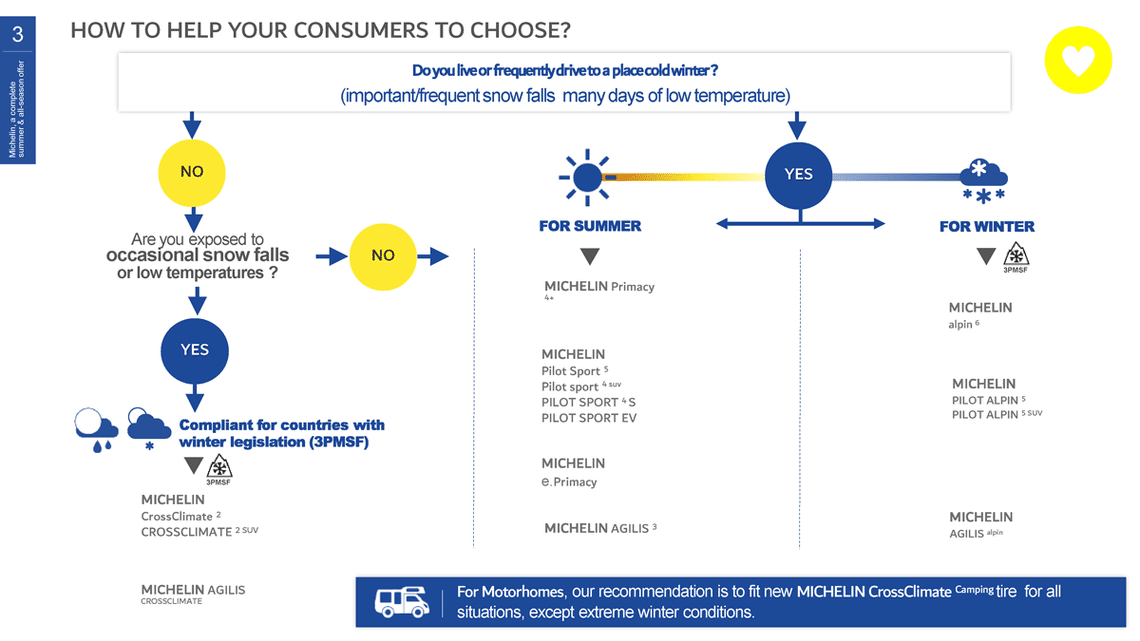
In this case, you can choose MICHELIN Alpin ⁶ for winter and MICHELIN Primacy ⁴ for summer.


Find tire dealers near you in seconds
Search among our dealers to find where your tire is available
FAQ
Read our Frequently Asked Questions.
Climate is the first filter. Your tires need to handle the worst conditions you regularly encounter — not just the average ones. After that: where you drive most (city, highway, mixed terrain), how you drive (comfort-focused, fuel-conscious, performance-oriented), and what the vehicle is used for (daily transport, towing, family trips). These four variables narrow the field considerably and point toward the right tire category before you even look at specific models.
Climate is the primary dividing line. If temperatures in your area regularly fall below freezing and you encounter ice or significant snow, all-season tires are not sufficient — you need either dedicated winter tires swapped seasonally, or all-weather tires rated for severe snow conditions. In climates where temperatures stay above freezing year-round, all-season or summer tires cover most needs. The 45°F threshold is a useful guide: below that temperature, the rubber in all-season and summer tires begins to harden and lose grip.
City and mixed driving puts a premium on braking performance, longevity, and wet-weather grip. Short trips with frequent stops accelerate tread wear, so a tire with a higher treadwear rating tends to provide better value over time. Quiet ride and low rolling resistance are secondary benefits worth considering. Grand touring all-season tires cover this use case well for most climates. If your city sees real winters, look for the Three-Peak Mountain Snowflake (3PMSF) rating on an all-weather tire for year-round use.
Dry and wet grip, steering response, and high-speed stability are the core priorities. Ultra-high performance (UHP) summer tires deliver the sharpest handling and braking but are designed for temperatures above 45°F. UHP all-season tires provide most of the same handling character with year-round usability, at a modest trade-off in peak dry grip. Look for a high traction UTQG grade (A or AA) and a speed rating that meets or exceeds the vehicle's factory specification.
Both matter, and they usually point in the same direction. Vehicle type sets the hard limits — load index, size, whether LT or passenger-rated tires are required. Within those limits, driving style determines which performance attributes to focus on. A crossover driver who does long highway trips needs different tires than one who tows occasionally or drives on unpaved roads. Michelin's tire selector tool uses vehicle type to narrow compatible options, and driving profile to rank them.
Most tire comparisons test products when they're brand new. But tires spend most of their service life in a partially worn state. A tire that performs brilliantly when new but deteriorates significantly by mid-life may offer less real-world value than one whose performance holds more steadily across the full tread life. Michelin designs its tires to perform from the first mile to the last, which means looking at long-term test data — not just new-tire scores — gives a more complete picture when comparing options.
Related articles
-

When to Replace Tires
There is no single rule that determines how long a tire will last. Tire lifespan depends on a combination of factors, including tire design, driving habits, climate, road conditions, and how well the tires are maintained.
Rather than relying on mileage alone, Michelin recommends regular inspections and paying attention to both visible signs and changes in performance that may indicate a tire needs to be replaced.View more -
Michelin-Developed Marked Tires
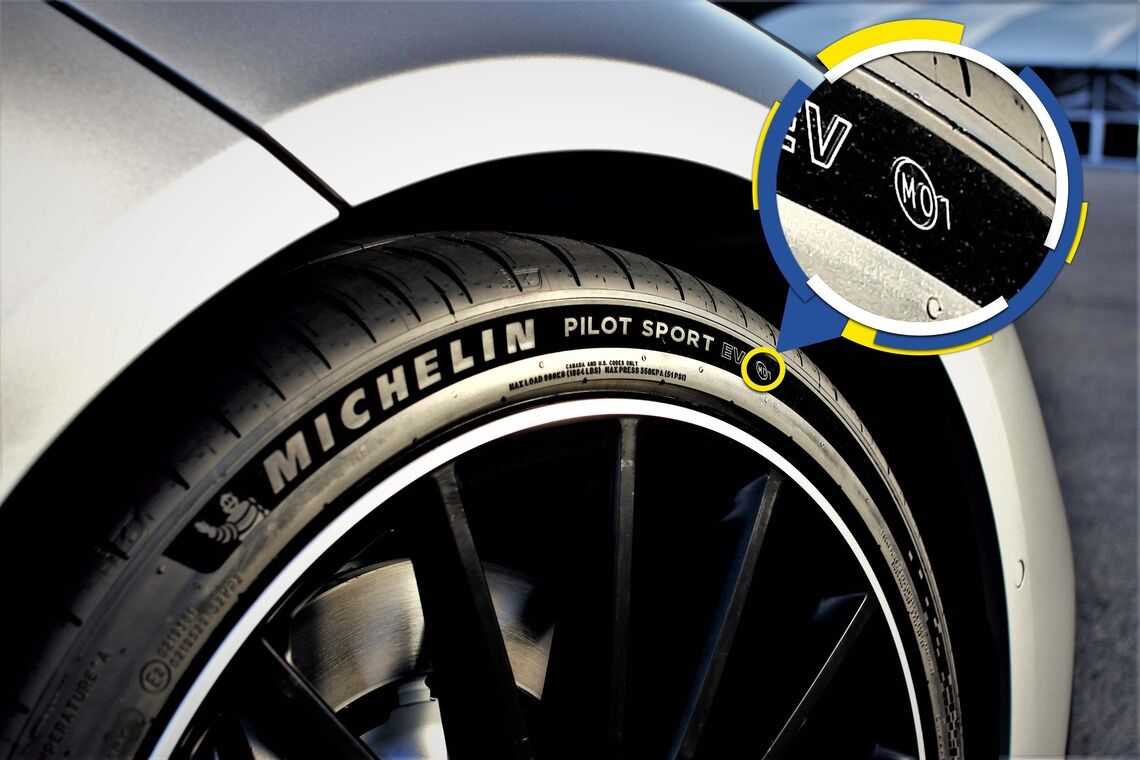
Michelin believes that close collaboration with vehicle manufacturers is essential when developing high-performance tires. Every vehicle has unique characteristics that influence how a tire should perform, including weight distribution, power output, chassis design, and suspension tuning.
Michelin-developed marked tires are engineered to match these vehicle-specific requirements. Designed and approved jointly by Michelin and the automaker, these tires are tuned to help ensure the tire performs as intended on the vehicle for which it was developed.View more -

Preparing for Your Visit to the Tire Dealer
Easily prepare for your visit to the dealer with Michelin's guide. Be sure to ask your tire dealer these 5 questions to ensure you get everything you need.View more -
What to Know Before Mixing Car Tires
Maintaining your car in the configuration set by the manufacturer is the safest approach for tire replacement. This means following the tire specifications outlined on your car's placard, in the owner's manual, and in any OE (original equipment) technical bulletins. This is essential, as these documents take into consideration how the car was built to manage load, steering, braking, and stability, especially when replacing just one or two tires.View more -

Choosing the Right Tire Size for Your Vehicle
Selecting the correct tire size is essential for proper fitment, performance, and safety. Tire size information is defined by standardized tire markings and can be found on the tire sidewall, in your vehicle owner’s manual, or on the vehicle tire information placard. Knowing where to locate this information and how to interpret it helps ensure replacement tires meet your vehicle manufacturer’s specifications.View more -
How to compare tires?
On what basis should you compare tires to select the one that will give you complete satisfaction? This article is about the main performance criteria to consider, the decision aids you can use and Michelin's best advice. We will discuss how to select the one you need within the same tire line and provide you with decision aids, such as independent tire tests, labelling and tire comparison sites. Finally, we will discuss another important criterion: long-term performance.View more -
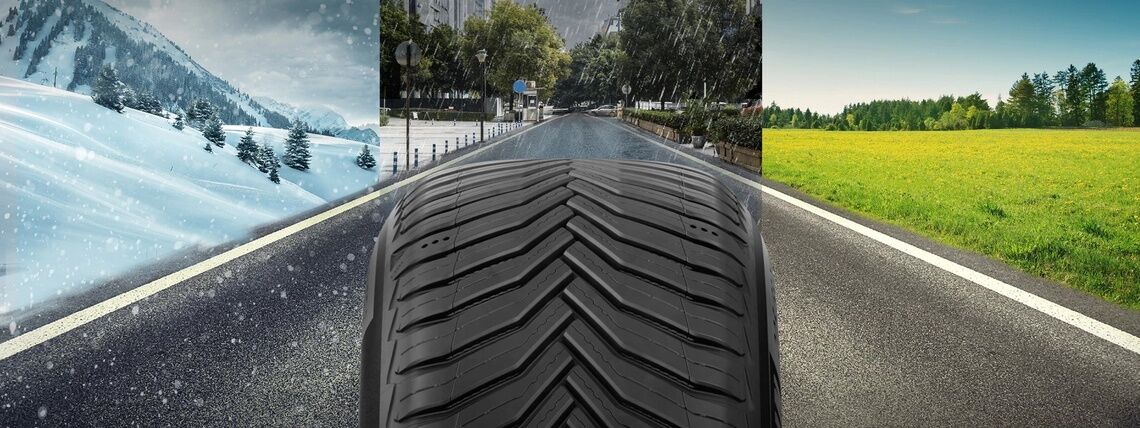
Differences in Types of Seasonal Tires
All-season / Summer / Winter tires: what is the difference?View more -

Winter Tire Buying Guide
Whether you are a first-time car owner, new to winter driving, or simply looking to make the safest choice for your vehicle, this guide covers everything you need to know about buying winter tires. From understanding the difference between winter, all-season, and summer tires to recognizing important tire symbols and studded options, here is how to stay safe through the coldest months of the year.View more -
Summer vs. Winter vs. All-Season Tires
Choosing the right tire depends on where you live, the time of year, and how you use your vehicle. Each tire type, summer, all-season, or winter, has unique strengths and limitations. Knowing when to switch helps you stay safe and maintain peak performance throughout the year.View more