- This hub covers the full maintenance cycle: daily pressure checks, tread and damage assessment, seasonal storage, de-winterization, break-in for new tires, and how to respond to handling problems that may be tire-related.
-

Tire wear and tear
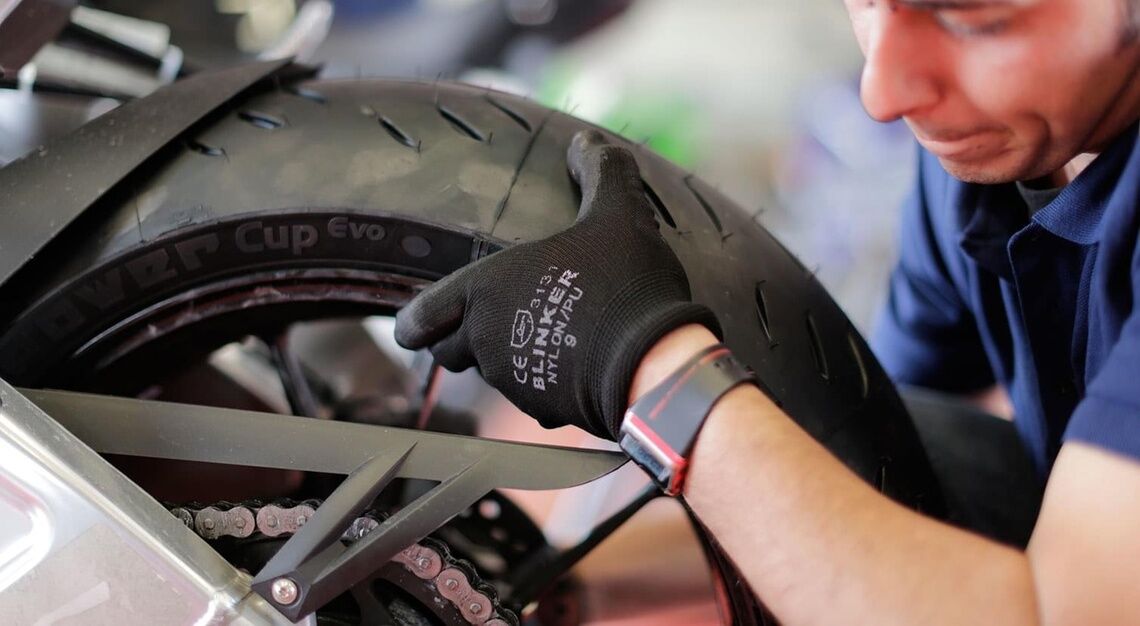
The rear tire wears fastest in the center from straight-line riding. As that center flattens, the transition into corners becomes noticeably less smooth: a change in feel that signals significant wear even if depth still looks adequate in the center groove. Check tread depth at multiple points across the full width of both tires, not just in the center, and use wear indicators and a depth gauge together to get an accurate picture.View more -

How to Check Your Tire Pressure
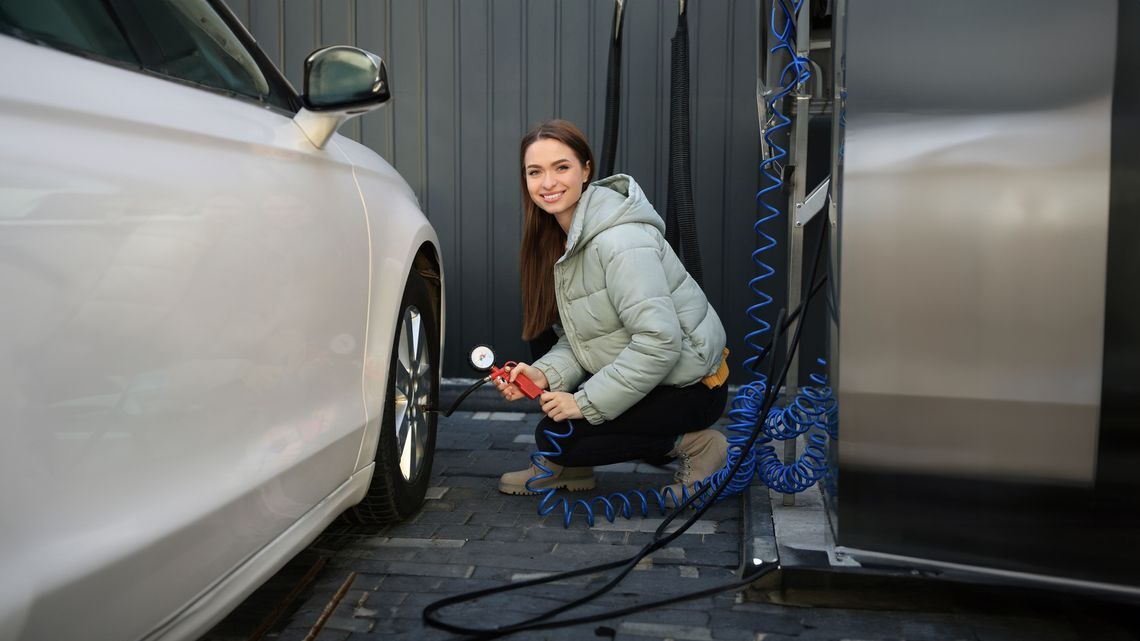
Check pressure before every ride, with the tires cold (not ridden in the last few hours). Use the cold pressure from your owner's manual or the vehicle information plate, not the maximum on the tire sidewall. Never bleed air from a hot tire to reach the cold pressure target: when the tire cools, it will be underinflated. Replace the valve cap securely after every check as it forms a secondary seal on the valve assembly.View more -

Track Tires Recommended Pressure
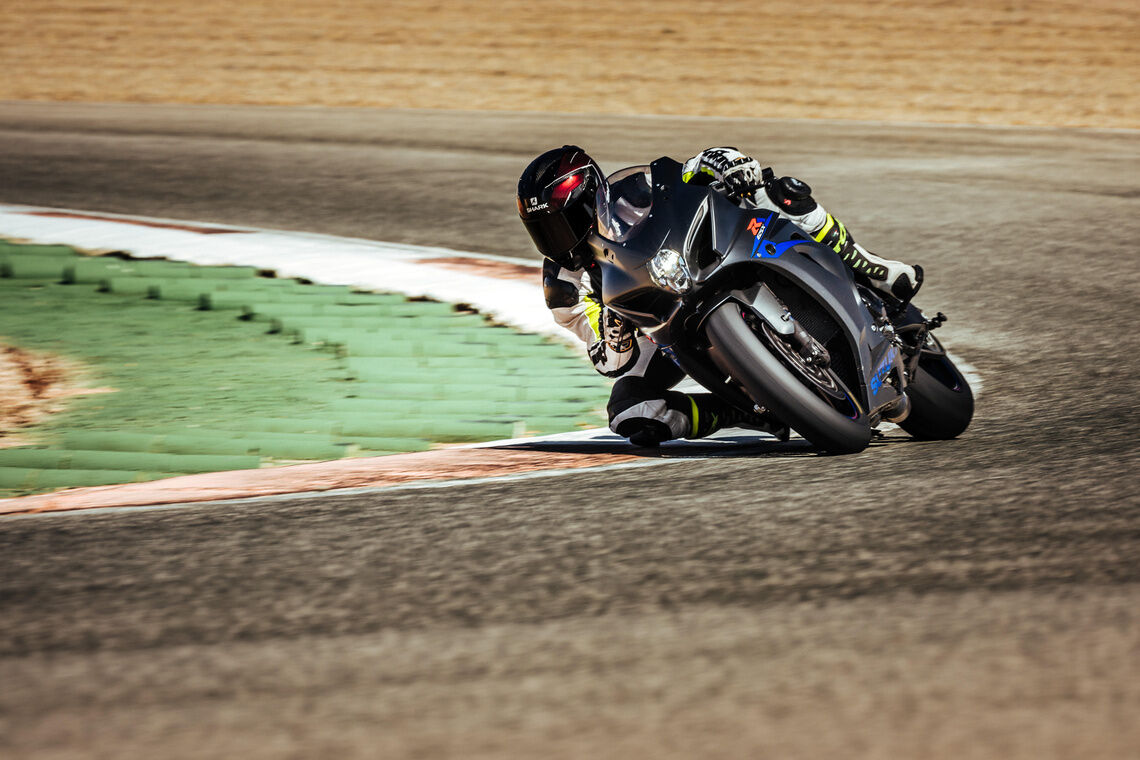
Start a track session at the manufacturer's recommended cold road pressure. As the tires warm through the first laps, pressure rises naturally: do not release air mid-session based on a hot reading. Allow a deliberate warm-up period for the first two to three laps, keeping lean angles moderate and braking forces gentle until the tires reach their operating temperature. Only then are the tires delivering the grip they were designed for.View more -

Off-Road
Correct inflation is essential for the safety and longevity of your tires. A tire gradually loses air over time. It is therefore essential to check its 'cold' pressure before each ride. If the pressure is checked when out on a ride (or soon after), be aware that the air in the tire is 'hot' - In fact, when riding, the pressure increases, so you should never deflate a tire that has just been ridden on.
If the pressure (when tested cold) is lower than the recommended 'cold' pressure, it is essential to replace the missing air. After checking, do not forget to replace the valve cap which is a core part of the seal (along with the valve itself). It is recommended to change the valve assembly and cap each time you remove/replace the tire, as it is key to ensuring the integrity of the whole assembly.View more -

Motorcycle Winter Storage: Essential Tips for Winterizing
View more -

De-winterize Your Motorcycle: Essential Checklist for Spring Riding
Before the first spring ride, check tires (pressure, any flat spots, sidewall cracking, tread depth), brakes (pad thickness, rotor condition, fluid level), chain (lubrication and tension), battery (charge and starting capacity), and all fluid levels. Take the first ride in a quiet, low-traffic area at gentle speed. Test brakes at low speed: light surface rust on the rotors clears with gentle braking. Only after confirming everything works correctly should you venture onto busier roads at full speed.View more -

Breaking in new motorcycle tires
Your motorcycle or scooter tires have reached a point where they need to be replaced. Once you've fitted your brand new tires, all you have to do is get on the road. But not just any old way! Your new tires need a break-in period without which the risk of a fall is possible. How to break in new motorcycle tires? Read our tips to get you through this phase without any problems.View more -

Why are motorcycle tires important?
Tires are an important part of what defines the shape and balance of a motorcycle or scooter.View more -

Motorcycle wheel balancing
Do you feel an abnormal vibration in the handlebars when you ride? Perhaps one of your wheels needs balancing. Read on to learn more about motorcycle wheel balancing.
Contents of the article:
What is a motorcycle wheel balancing?
What causes a wheel to become unbalanced?
When should a wheel be balanced?
Motorcycle wheel balancing: the off-road exception
How is a wheel balanced?
Can I balance a wheel myself?View more -

Motorcycle maintenance: How to maximise tire life
Your tires are the only part of the vehicle in contact with the road looking after them is an essential part of motorcycle. Regular maintenance doesn’t only allow you to maximise tire life, but also performance. So, what’s the most effective way to maintain your motorcycle tires? Allow our experts to explain.View more
Related topics
Frequently Asked Questions
Checking tire pressure before every ride. A motorcycle relies on two small contact patches for all braking, steering, and stability — incorrect pressure immediately affects all of these. Check cold (before riding) and compare to the manufacturer's recommended pressure for the expected load. Never deflate a hot tire based on a warmed reading. This one habit, done consistently, protects both safety and tire life more than any other single action.
Before every ride, do a quick visual check: look for embedded objects, sidewall damage, and any deformation. A more detailed inspection — checking tread depth at multiple points across the tire's width, looking for cracking, and examining the entire sidewall — should be done at least monthly or before any long journey. Also inspect after any unusual event: a hard impact with a pothole, riding on a damaged road section, or any incident where the tire may have taken a hit.
When tread reaches the wear indicator, when any damage is found that can't be safely repaired, or when the tires reach ten years from the manufacture date — whichever comes first. The wear indicator is the minimum; Michelin recommends annual professional inspection after five years of use. Unusual or asymmetric wear patterns should also prompt replacement or investigation of an underlying cause (pressure, alignment, suspension).
Directly. Hard acceleration spins the rear wheel and scrubs rubber from the center tread. Hard braking transfers load to the front and wears the front tire's contact zone. Aggressive cornering loads the outer edges of both tires. None of these are avoidable entirely, but smooth, progressive inputs extend tire life compared to abrupt, high-stress riding. Checking tire pressure regularly ensures wear happens at the correct rate rather than accelerated by an underinflation condition.
Not necessarily — rear tires typically wear faster than fronts because they carry more load and drive the motorcycle. Replace each tire when it reaches the wear indicator or shows signs of damage, regardless of the other tire's condition. However, always use matching front and rear tires from the same product line — a new rear with an old front from a different brand creates mismatched handling characteristics.
Multiple factors interact:
Riding style — harder acceleration, braking, and cornering wear tires faster
Tire type — sport tires wear faster than touring; commuter tires are optimized for longevity
Tire pressure — correct pressure distributes load evenly; incorrect pressure causes localized accelerated wear
Load — regular two-up riding or heavy luggage accelerates rear tire wear
Road surface — rough or abrasive surfaces wear tires faster
Temperature — very hot conditions accelerate compound wear