How to Store Different Types of Bike Tires
Let's start with a few general recommendations.
- Store in a dry, dark place: Avoid direct sunlight and humidity.
- Keep away from extreme temperatures: Avoid storing below 0°C (freezing) or in excessive heat.
- Avoid ozone exposure: Air conditioners and electrical equipment can generate ozone, which accelerates tire degradation.
- Keep away from chemicals: Do not store near solvents, fuels, or strong chemicals that can damage rubber compounds.
Storing Tubeless Ready Tires
If you are planning to go on holiday for a long period, we recommend that you remove your Tubeless Ready tires and also the sealant inside. If you've only been using this fluid for a short time, you can store it in a closed container to prevent it coming into prolonged contact with the air.
Why is it important to remove the tire before storage?
Because if the tire remains mounted and static for a long period of time, the fluid will accumulate at the bottom of the tire. And as the tire gradually loses its pressure, it will deflate at the very point where the fluid has settled, allowing air to enter. On contact with the air, the liquid will harden... if it hasn't already spilled outside the tire!
If the liquid has coagulated, it will obviously no longer be able to seal the tire.
If you're coming back after a long period and hadn't thought to take the precautionary steps mentioned above, we recommend that you take a bead out of the tire and check the state of your sealant before setting off on your bike. If the fluid is still in the tire, simply replace the bead, reinflate and ride. If the fluid has already coagulated, remove all the residue (you can do this quite easily by scraping with a fingernail). Then reinject new sealant.
Storing Tubetype Tires (With Inner Tubes)
If they are fitted, avoid leaving them like this for too long. Over time, they will deflate and the weight of the bike will eventually create small cracks. If you can't dismantle the wheels and hang them up, the best thing to do is to turn your bike over.
Should Tubetype tires be folded before storage?
When storing Tubetype tires, make sure you fold them as they were in their original packaging. A tire with a soft bead that has been demounted can be folded, but you should never fold tires with a rigid bead.
If you have bought tires that were originally folded, there is no need to keep them unfolded for storage. If you know you won't be using them straight away, you can fold them without any problem. However, if the tire is still in its original packaging, there is no reason to take it out.
Storing Tubular Tires
Tubular tires should be stored in the same way as rigid beaded tires. Do not fold them and hang them up in a dry place away from light.
We'd like to take this opportunity to remind you of a few precautions to take with tubular tires before you ride them for the first time. Tubular tires are not manufactured in the same way as Tubetype tires: since solvents are applied at the factory, it's important to let them evaporate before the first use: before rolling, inflate your tire (not necessarily to maximum pressure) so as to stretch the casings and leave it for 24 hours. This time is necessary for the solvents to evaporate completely.
How Long Can You Keep Bike Tires?
Michelin recommends that tires be removed from service ten years from the date of manufacture. The ageing of a tire depends on the conditions in which it has been stored and the way in which it has been used. For example, a new tire parked or stored next to a transformer can show, in just a few days, irreversible sidewall damage (cracking), which will affect its performance and pressure resistance. So be sure to follow our advice to preserve your stored tires for as long as possible!
FAQ
Read our Frequently Asked Questions.
Four conditions matter: dry (avoid humidity), dark (avoid UV and direct sunlight), cool (avoid extreme heat above room temperature and cold below freezing), and away from ozone sources (air conditioners, electric motors, and generators generate ozone that degrades rubber compounds rapidly). A tire stored next to a transformer or electric motor can develop sidewall cracking in days. These conditions apply to both mounted tires on the bike and unmounted tires in storage.
Remove the wheels and hang them up, or turn the bike upside down so it rests on the handlebars and saddle. Both approaches remove the weight of the bike from the tires, preventing the sustained static load from deforming the tires and potentially causing flat spotting or sidewall stress. If the bike must remain on its tires, inflate to the correct pressure and check monthly. For tubeless setups, Michelin recommends removing the tires and the sealant if storing for a long period — dried sealant inside a stored tire can be difficult to remove later.
Folding bead tires (those with aramid or Kevlar beads) can be folded for storage, as the flexible bead allows this without damage. If a folding bead tire was originally sold folded, it can be re-folded for storage. Rigid wire bead tires must not be folded — the steel wire bead will kink and permanently deform if bent sharply, compromising the tire's ability to seat on the rim correctly. Store wire bead tires as a round shape, standing upright or hanging.
Don't fold tubular tires. Store them in the same way as rigid bead tires — as a circle, hanging in a cool dark location. Tubular tires should not be folded because their sewn casing and the inner tube within would be stressed and could develop problems. If storing a spare tubular for road use (pre-stretched and ready for emergency use), roll it loosely and carry it in a saddle bag or jersey pocket — but don't store it folded long-term.
Michelin recommends removing tires from service ten years from the date of manufacture, regardless of storage conditions. Rubber degrades through aging even without use, and a tire stored for many years may look acceptable on the outside while having a degraded compound that cracks under pressure or offers reduced grip. Check the manufacture date on the tire or packaging. If storing new tires long-term before use, keep in the original packaging and follow the storage conditions above.
Slight deflation is advisable for very long storage, but don't deflate completely. A completely flat tire allows the weight of the bike to rest directly on the rim through the collapsed tire, which can stress the rim and bead area. Reduced pressure — enough to maintain the tire's shape without being fully inflated — is better for winter storage. For tubeless setups with sealant, avoiding complete deflation also prevents the sealant from pooling excessively in one area.
Related articles
-

How to break in new tires properly
New bicycle tires carry a manufacturing release agent on the outer surface that reduces grip until it wears away through road contact. During the first few rides, avoid aggressive cornering, emergency braking, and slippery surfaces. Tubular tires additionally need 24 hours of inflation before first use to allow manufacturing solvents to evaporate from the casing. Grip improves progressively as the surface agent wears off, typically over the first three to four rides.Learn more -

What should I do if my back bike wheel wobbles?
You're riding your bike and you feel a bump at the rear with each turn of the wheel, a lateral or vertical shake, which is not only unpleasant but can also, in some cases, destabilise the bike and even lead to a fall. It is therefore important to deal with the problem as quickly as possible to enjoy a better cycling experience. So what should you do if your back bike wheel wobbles? Find the answers in our article.Learn more -
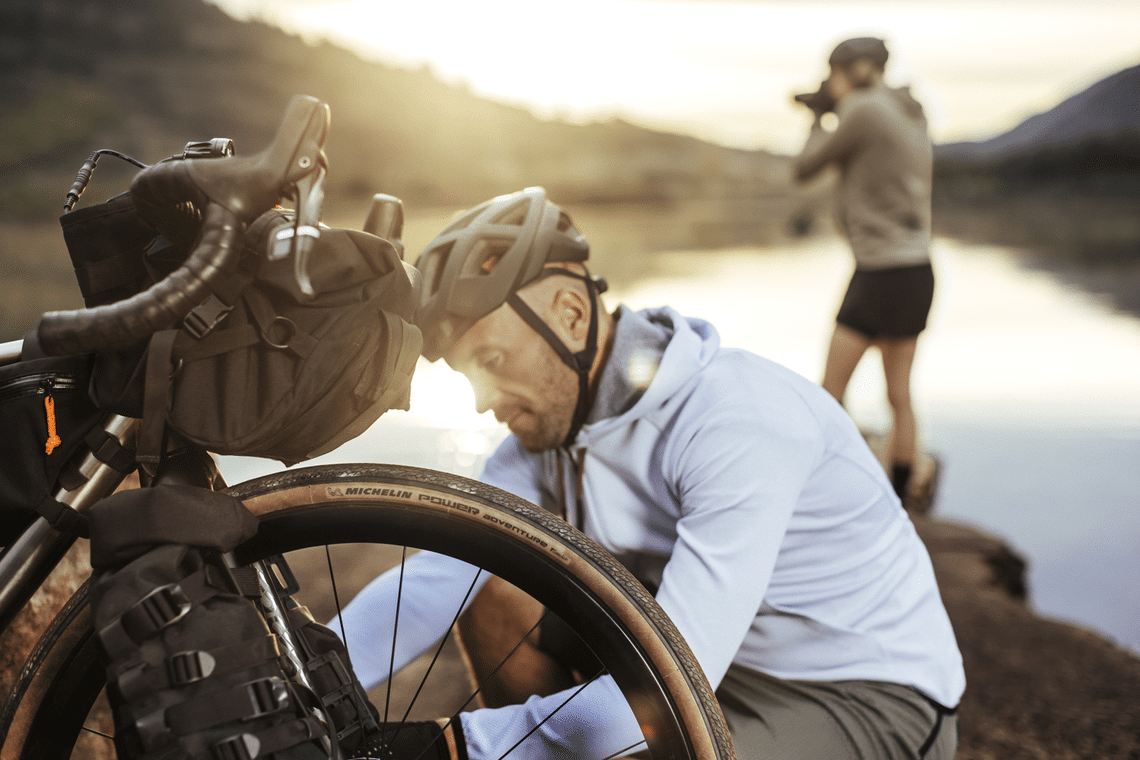
How to use bike tire sealant ?
Tire sealant is a game-changer for cyclists, offering automatic puncture repair and improving the performance of tubeless-ready tires. Whether you're riding on the road, gravel, or mountain trails, knowing how to apply and maintain tire sealant can help prevent flats and extend the life of your tires. In this guide, we’ll cover why you need tire sealant, how to apply it, and best practices for maintenance.Learn more -

How to improve bike puncture resistance
Three types of punctures affect bicycle tires differently and require different prevention strategies. Perforation punctures from glass, nails, and thorns are reduced by tighter casing construction and thicker tread rubber. Pinch flats from low pressure combined with a hard impact are eliminated entirely by switching to a tubeless setup. Rim-side punctures from damaged rim tape are prevented by replacing the rim tape every time you replace the tire. Each type has a specific and practical prevention.Learn more