Why Tire Rotation Is Necessary
During regular driving, the stress experienced by the front and rear tires is not evenly distributed. Front tires tend to wear faster due to factors such as steering input, braking requirements, and cornering forces, whereas rear tires wear more evenly. If tire rotation is not done on a regular basis, these differences may become increasingly apparent, resulting in uneven tread depth, lower grip, and a shorter tire lifespan. Over time, uneven wear can increase road noise or vibrations and affect how the vehicle responds during acceleration and steering.
Consistent tire rotation has the following benefits:
Ensure even tread wear across all four tires
Maintain consistent handling and braking performance
Increase the life of your tires
Provide reliable traction in wet or dry conditions.
Recommended Tire Rotation Intervals
Rotating tires every 5000 to 7000 miles, or every other oil change, is our standard recommendation; however, as always, the vehicle manufacturer's guidelines should be followed. Rotation may be needed sooner if uneven wear is noticeable or if you drive frequently in stop-and-go traffic, carry heavy loads, or on rough road surfaces.
Tire rotation is often performed during scheduled maintenance alongside wheel balancing and wheel alignment checks, which further support even tire wear and vehicle stability.
Maintaining correct tire pressure between rotations is also important. Some drivers prefer nitrogen inflation as it reduces moisture inside the tire and slows pressure loss over time. Consistent tire pressure promotes even tread wear, which can help to extend tire life when combined with regular rotation.
Tire Rotation Patterns by Vehicle Type and Drivetrain
Using the proper rotation pattern is crucial and the suggested approach differs depending on the vehicle type and drivetrain.
Front-Wheel Drive (FWD)
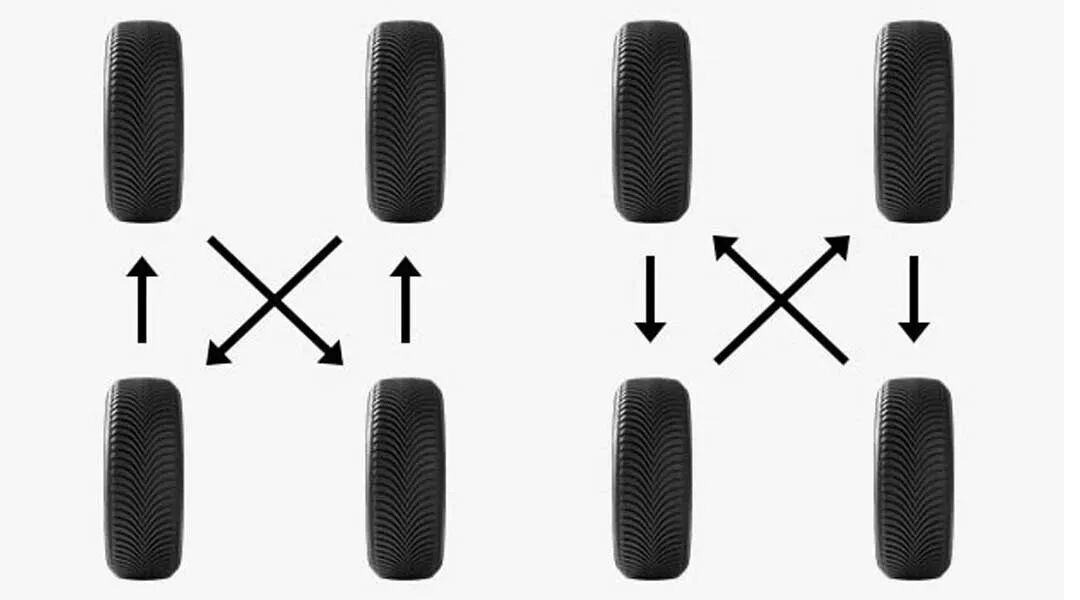
Front-wheel drive vehicles place more wear on the front tires. A common rotation pattern moves the front tires straight to the rear, while the rear tires cross to the front.
Rear-Wheel Drive (RWD)
Due to acceleration forces, rear-wheel drive cars exert greater stress on the rear tires. Moving the rear tires straight to the front and the front tires cross to the rear is the rotation pattern we recommend. This ensures balanced wear between the drive and steering axles, supporting even tread wear and maintaining consistent handling.
All-Wheel Drive (AWD) and Four-Wheel Drive (4WD)
AWD and 4WD vehicles usually require more frequent rotation to provide uniform tread depth across all tires. Unless the vehicle manufacturer specifies otherwise, tires are typically rotated in a crisscross pattern. Matching tread depth helps protect driveline components and supports balanced traction.
Directional Tires
Directional tires are designed to rotate in only one direction. These tires must stay on the same side of the vehicle and are rotated front to rear only.
Staggered Tire Setups
For vehicles equipped with run-flat tires, rotation should always involve a complete inspection, including a visual inspection of the tire's condition. Even if there is no obvious damage, run-flat tires may endure internal stress after being driven with low or no air pressure. A skilled professional can confirm whether the rotation is appropriate and ensure that the tires are safe to use.
If you’re unsure which rotation pattern applies to your vehicle, a Michelin tire professional can help determine the correct approach. You can find a qualified specialist near you using Michelin USA’s Dealer Locator.
When performed regularly and according to the correct rotation pattern, tire rotation helps support even tread wear, balanced handling, and long-term tire performance. Combined with proper inflation, visual inspection, wheel alignment, and wheel balancing, rotation plays an important role in maintaining safety, comfort, and efficiency throughout the life of your tires.



Find tire dealers near you in seconds
Search among our dealers to find where your tire is available
FAQ
Read our Frequently Asked Questions.
Rotation means moving each tire to a different position on the vehicle — front to rear, side to side, or a combination depending on the drivetrain and tire type. Tires wear at different rates depending on where they sit. Front tires on a front-wheel-drive car carry the braking, steering, and drive loads simultaneously, so they wear faster than the rears. Rotation redistributes that wear across all four tires, extending the life of the set and keeping handling balanced.
Follow your vehicle manufacturer's schedule, found in the owner's manual. As a general guideline, most manufacturers recommend rotation every 6,000 to 8,000 miles. Some tire warranties specify a rotation interval as well — missing it can void the mileage coverage. If you notice any sign of uneven wear before reaching that interval, rotate sooner rather than waiting.
Yes. Even wear that looks uniform to the eye often develops into an uneven pattern over time if the tires stay in the same positions. Regular rotation is what produces that even appearance — it's the cause, not a sign that rotation can stop. Once rotations stop, the balance tends to break down fairly quickly.
Yes. Directional tires — those with a V-shaped tread designed to roll in one direction — can only move front to rear on the same side of the vehicle. Crossing them left to right would require demounting and remounting. Staggered fitments, where rear tires are wider than fronts (common on sports cars), may not allow rotation at all without a size change. Check your tire sidewall for a direction arrow and your owner's manual for fitment details before assuming a standard rotation applies.
It's a good opportunity to ask for one. Alignment doesn't shift with every rotation, but catching a drift early prevents one position from wearing faster than the others before the next service. Most shops will check alignment during a rotation and flag anything that looks off. A full adjustment is only done when measurements show it's actually needed.
It can, briefly. Tires develop minor wear patterns specific to their position over thousands of miles. Moving them to a new position can produce a slight change in road noise or vibration for a few hundred miles while the tire settles in. This is normal and temporary. If handling or vibration is significantly worse after rotation, have it checked — it may point to an underlying balance or suspension issue that the previous wear pattern was masking.
Related articles
-
Why is tire maintenance important?
Tires lose air naturally, around one PSI per month, even without a puncture. Running a few PSI below the recommended pressure consistently shortens tire life, increases fuel consumption, and in severe cases can lead to a structural failure at highway speed. This page explains the specific consequences of neglected tire maintenance so the case for regular checks is clear and concrete.View more -

How to Change a Car Tire?
Changing a flat tire on the roadside takes about 20 minutes when you have practiced beforehand. Before you need to do it at night on a busy road, confirm your spare is in the trunk and inflated, find your jack, and know how to use both. This step-by-step guide covers vehicle positioning, safe jacking, lug nut sequence, and what to check before driving away on the spare.View more -

How to Properly Inflate Your Car Tires
Tire inflation is an important factor to ensure your safety and that of your passengers. If your tire pressure is incorrect, it can also impact your vehicle's operating costs through premature tire wear and higher-than-normal fuel consumption.
In this article, you will learn when you should check your tire pressure and how to inflate tires in 3 simple steps. You will see that tire inflation has to be done differently depending on whether your tires are cold or warm and that the spare wheel should also be checked regularly, although not as often as the other tires.
We will also address the question of the portable tire inflation compressor as an alternative to gas stations and help you decide if you should inflate tires with nitrogen.View more -

Can My Tire be Repaired?
A nail in the tread that has not gone all the way through may be repairable. A nail in the sidewall never is. The qualifying criteria for a safe repair are specific: the puncture must be confined to the tread area, be no larger than 1/4 inch (6mm), and be assessed by a professional with the tire off the wheel. Sidewall damage, run-flat damage, and any tire that was driven flat require replacement, not repair.View more -
Wheel Alignment and Balancing: Why They Matter
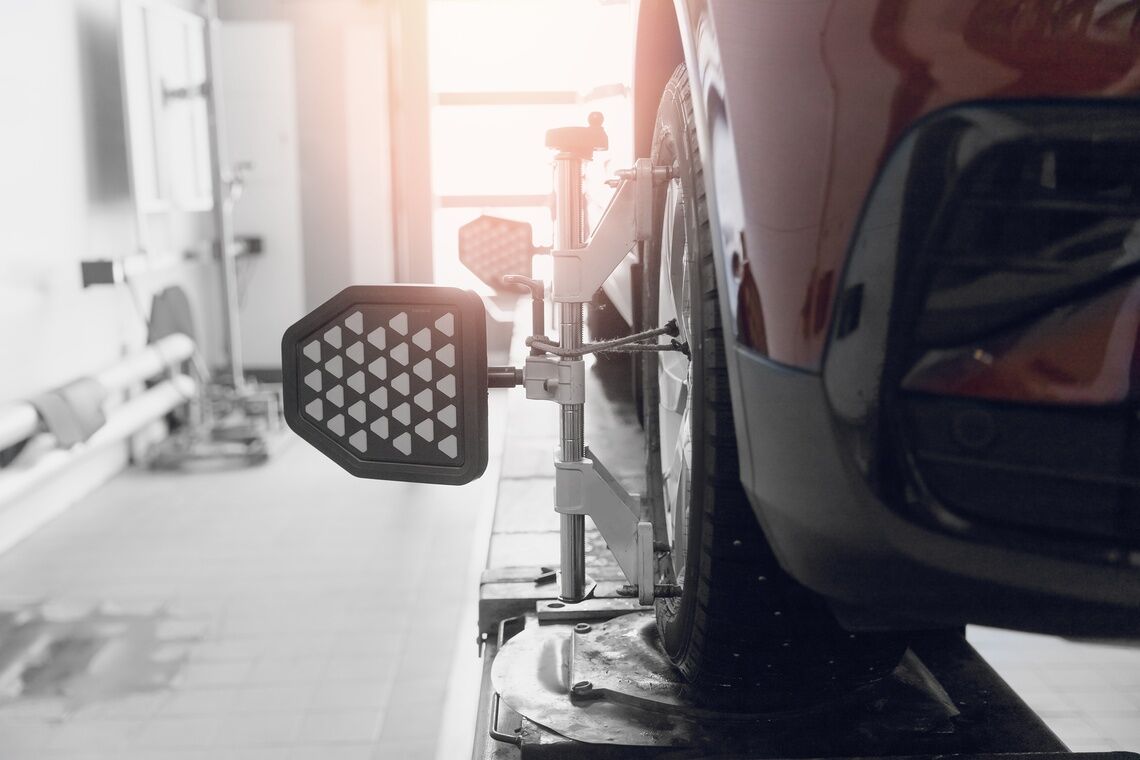
Wheel alignment and wheel balancing are important yet often misinterpreted services that impact tire performance. While these services are frequently recommended together, each addresses distinct issues that significantly influence tire wear, vehicle handling, and operational efficiency.
Understanding how alignment, balancing, mounting, and wheel fitment work together can help you protect your tires, improve driving comfort, and avoid unnecessary wear.View more -

Visual Tire Inspection Before Installation
Before installing new or used tires, perform a thorough visual check. This step ensures proper mounting and supports optimal tire performance. Skipping or hurrying through this phase may result in vibrations, air loss, handling issues, or premature tire wear after installation.View more -
Routine Tire Care Tips
Four habits protect your tires and your safety: check pressure monthly with a gauge, rotate every 6,000 to 8,000 miles, get alignment checked annually or after any significant impact, and keep tires clean by rinsing with water after exposure to road salt or chemicals. None of these require specialist skills or expensive equipment. This page lays them out so you can incorporate them into your regular vehicle routine.View more