What is a motorcycle tire tread depth?
A motorcycle tire's tread depth is what tells you how worn the tire is. It is measured vertically from the top of the tread to the base of its grooves.
The more a tire rolls, the more the rubber erodes. And the closer the erosion is to the base of the grooves, the less the tire performs (especially in wet conditions). For this reason, a safety threshold has been set by the legislation of each country. Above this threshold, it is considered unsafe to drive.

Where to measure your tire's tread depth?
Legally, both the shoulder wear and tread wear should be taken into consideration. If the legal or technical wear limit has been reached at one point on the tread, the tire must be replaced.
Motorcycle tire tread depth when new
Some tires have a shallow tread when new. In particular track tires that are also approved for road use.
Although the tread depth is shallower, the legal wear limit is the same as for conventional road tires.
MICHELIN Power GP, homologated for track and road usage, has a shallow tread when new.
How to check tire tread depth?
Tire wear indicators are included in the tire design, inside the treads. They give a good indication of how worn your tire is. When the wear is close to the wear indicators, it means that the tire needs to be changed.
How do I find the wear indicators on the tire?
Wear indicators are nestled in the hollows of the treads. Since they can be difficult to find, manufacturers usually carve markers into the tread.
Michelin tires, for example, have little 'Michelin Man' markings on the rubber. They are there to indicate the location of wear indicators.
1 - Identify the Michelin Man symbol
2 - Find the closest motorcycle tire wear indicator in a main groove
Other tire brands simply indicate "TWI" for "Tread Wear Indicator" on the tire to tell you where it is located.
Motorcycle tire tread depth measurement tool
There is another way to measure the wear of your tires. Simply buy a special measuring tool from a dealer. By inserting it into the grooves, you can determine the level of wear very precisely.
Michelin has developed a digital tool that combines two functions:
tire depth control
pressure control
All you have to do is place the small needle in a groove and the depth is immediately displayed in millimetres on the digital screen.
To find out the pressure of your tire, you insert the nozzle into the valve, and it is displayed in bars on the screen.
What’s the legal requirement?
All tire manufacturers include wear indicators in their tires with a height of 0.8mm. However, it is important to know that this value is indicative and allows you to know, when the wear level is approaching it, that it is time to change the tire.
It is your responsibility to ensure that the wear level of your tires never passes this legal limit.
Driving over the legal limit carries significant risks
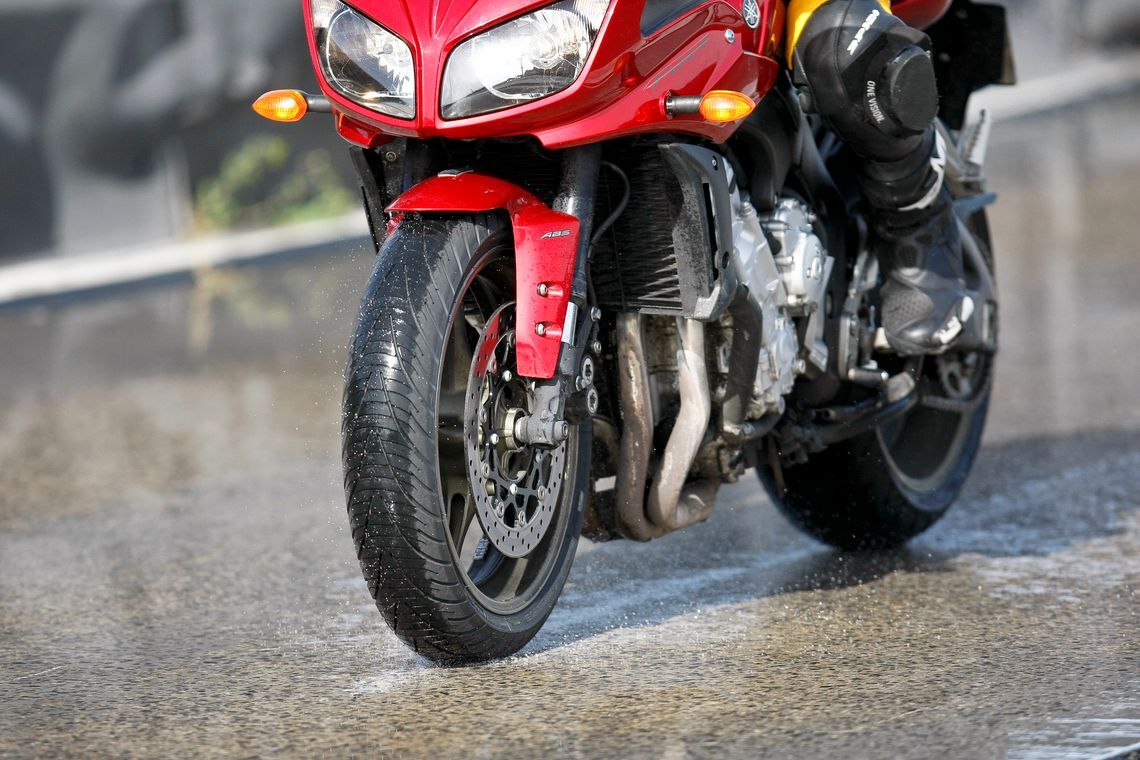
By driving beyond this limit, you would not only be breaking the law. You would also be putting yourself at risk. When you reach this limit, your tires are less efficient because they have hardly any tread left. In rainy weather, for example, water can no longer drain away and the risk of a fall is therefore high.
Once the treads are worn away, erosion can reach the tire plies and the carcass can fail, which is a dangerous deterioration for your safety.
When to check the wear level of your tires?
We recommend that you check the wear level of your tires every time you check your tire pressure, which should be done once a month.
What causes tire wear?
It is important to differentiate between normal tire wear, which occurs over time through driving, and premature wear, which can lead to an earlier tire change.
Premature wear can sometimes be avoided in order to preserve your tires and allow you to enjoy their performance for longer.
Incorrect pressure, for example, can cause more pronounced wear on the centre of the tire (in the case of over-inflation) or on the shoulders (in the case of under-inflation) and therefore lead to an earlier tire change. Check your tire pressure once a month so that it corresponds to that recommended by the manufacturer.
Transmission, fixings or a very sporty driving can also cause premature wear. If you have any doubts, contact your local tire dealer.


Dealer Locator
Search among our dealers to find where your tire is available
FAQ
Read our Frequently Asked Questions.
Federal regulations require a minimum of 1/32 inch for motorcycle tires, but some states mandate a higher minimum. New York and Texas, for example, require 2/32 inch. Always check the requirements in your state rather than assuming the federal minimum applies. Tires worn below the legal minimum in any jurisdiction where you ride are both illegal and unsafe — the legal minimum also marks the point where wet-weather grip has significantly declined.
Use the built-in tread wear indicators molded into the tire's grooves, or use a tread depth gauge. On Michelin motorcycle tires, a small symbol on the sidewall marks the location of the nearest indicator. When the tread surface is flush with the indicator, the tire has reached the minimum. Measure at multiple points across the tire's width — motorcycle tires wear in patterns related to riding style, so center wear and edge wear can be very different.
Wet-weather grip begins to decline before the absolute wear limit is reached. For a motorcycle — where a loss of grip has more immediate consequences than in a four-wheeled vehicle — the practical replacement point for regular riding, especially in wet climates, is often before the legal minimum. The legal minimum is the absolute floor; the practical decision for a motorcyclist riding in rain involves considering how much performance margin remains at that depth.
The tread grooves pump water out from between the tire and road as the wheel rotates. As depth decreases, this channeling capacity reduces, and the risk of the tire riding up on a film of water — aquaplaning — increases. On a motorcycle, aquaplaning causes a sudden and complete loss of grip on the affected tire, which can cause an immediate fall. Monitoring tread depth carefully and replacing before the wet-weather performance threshold is a direct safety decision.
Yes. Car tires wear relatively uniformly across the tread because they don't lean. Motorcycle rear tires develop a distinctive flat spot in the center from straight-line riding — the center of the tread wears faster than the edges, giving the tire a squared-off profile over time. Front tires wear more evenly. This different wear profile means tread depth can look adequate in the center while being very low at the edges, or adequate at the edges while the squared center changes cornering feel significantly.
As the rear tire's center wears faster than the edges, the tire profile transitions from a rounded cross-section to a flatter one. This changes the transition when leaning into a corner — the rider feels a step or notch as the tire rolls from the flat center section to the rounder edge section, rather than a smooth progressive lean. This feel change is a signal that the tire is significantly worn, even if there appears to be remaining depth in the center. It's one of the reasons to replace motorcycle tires based on profile change as well as depth measurement.