Your safety is our priority
The tire plays a major role since it is the only link between the ground and the vehicle. So it is important to choose the right tire for the right usage.
Michelin helps you choose your tires and maintenance, and to identify handling difficulties.
Why do tires matter?
Tires play an essential role because they are the only link between the vehicle and the road.
Maintain your tires
To get the most out of your tires you’ll need to maintain them properly. It’s not as complicated as it sounds, and we’re here to help.
Recognize handling difficulties
It isn't always easy to get to the bottom of the reasons for different performance issues.
Tires aren't always the only factor to consider.
When should I change my tires?
Worn tires can ruin your vehicle's performance and even endanger you or your loved ones.
Improving road safety
Governments, international organizations and businesses must step up their efforts to make roads safer for everyone, and run awareness-raising and training schemes for all road users.
Riding safely in winter
Raise your body temperature by getting active. Move around on your motorcycle, one leg after the other, one arm and then the next.
FAQ
Read our Frequently Asked Questions.
Motorcycle tires are the only contact point between the vehicle and the road — everything the rider inputs (steering, braking, acceleration) and everything the road surface delivers (traction, feedback, hazards) is mediated through two small contact patches. In a car, four tires and thousands of pounds of vehicle provide a larger margin for error. On a motorcycle, the consequences of a tire that's under-maintained, wrong for the conditions, or at incorrect pressure are more immediately felt.
Incorrect pressure on a motorcycle has more immediate handling consequences than on a car. An underinflated front tire makes steering heavy and vague, increasing effort and reducing response. An underinflated rear tire feels unstable under acceleration and braking. Overinflated tires reduce the contact patch and transmit road impacts more harshly through the bike. Correct pressure, checked cold before each ride, keeps the tire in its designed operating state for the handling and feedback it was built to provide.
Apply both brakes progressively together — front and rear — rather than relying on one alone. The front brake provides more stopping force because weight shifts forward under braking and loads the front tire. The rear brake alone is less effective and more likely to cause wheel lock. However, applying the front brake abruptly without the rear can also cause instability. Learn to feel the balance point where both brakes are working effectively without wheel lock, and practice smooth, progressive application.
A motorcycle puncture is a more serious event than a car puncture because the bike relies on only two tires for stability. If a rear tire slowly loses pressure while riding, the bike becomes unstable — reduce speed carefully, avoid sudden inputs, and come to a safe stop. A front tire puncture is more dangerous; the front tire's role in steering makes any sudden pressure loss potentially unmanageable at speed. Pull in the clutch gently, avoid braking hard, and allow the bike to slow gradually. Do not attempt to ride on a flat motorcycle tire.
Michelin recommends against mixing brands between front and rear. Front and rear motorcycle tires are designed as systems — the profiles, compounds, and handling characteristics of matched sets are developed to work together. Mixing brands can produce mismatched handling characteristics between the front and rear axles, which affects stability and predictability in cornering. Use matching front and rear tires from the same product line wherever possible.
The motorcycle tire's contact patch changes shape as the tread wears down — particularly on the rear tire, which develops a flat spot in the center from straight-line riding. This flat spot changes cornering feel because the transition from straight to leaned riding becomes less smooth. Beyond the feel change, reduced tread depth reduces wet-road grip as on any tire. Check tread at multiple points across the tire's width, not just in the center groove, and replace when the wear indicators are reached.
Related articles
-
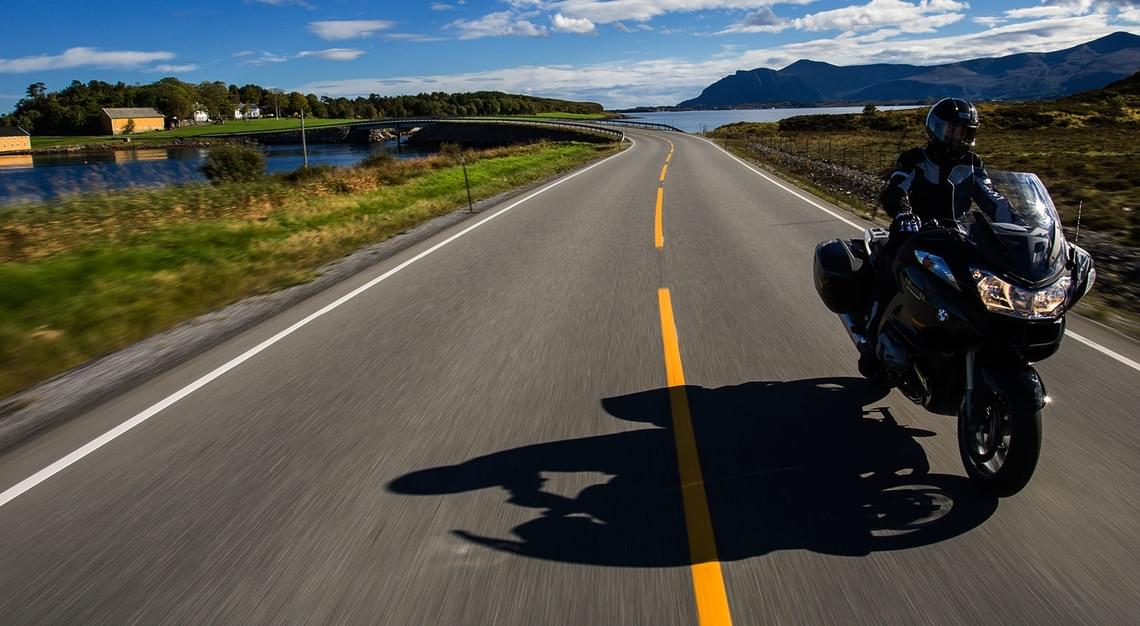
Tips to enjoy your motorcycle trip
Check tire pressure before every ride. On a motorcycle, even small deviations from the correct cold pressure change handling feel in ways that affect both comfort and safety. For the first few minutes of every ride, especially in cold weather, keep lean angles moderate and braking gradual: tires need time to reach operating temperature, and grip is at its lowest in the first several minutes before the rubber warms up.View more -
Improving road safety for everyone
Michelin is keen to step up to the plate in a bid to save more and more lives.View more -
Recognize tire handling difficulties
Handlebar vibration at specific speeds is usually wheel imbalance: go to a professional. A wobble (side-to-side oscillation of the handlebars) is often linked to high wear or incorrect pressure: loosen your grip slightly and reduce speed smoothly without braking hard, then have the motorcycle inspected. Weave at high speed requires smooth deceleration only: no sharp braking or acceleration. Any new or worsening handling sensation warrants a professional assessment before the next ride.View more